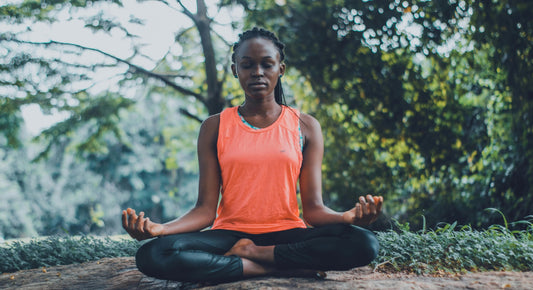
Avoiding Common Pitfalls in Meditation

Meditation is often presented as a universal key to well-being. You simply close your eyes, breathe deeply… and let calm settle in. Yet for many women discovering this practice — often during a moment of emotional fatigue, mental overload, or inner searching — reality can look very different. We sit down full of hope, press "play" on a guided meditation, and instead of the promised peace, up come impatience, doubt, tension, or even guilt.
This gap isn't a failure. In fact, it's very common. And it reveals a point that's often underestimated: meditation can come with pitfalls, especially when approached without preparation or with unrealistic expectations.
The most common trap: wanting to "meditate well"
There's this idea, sometimes deeply ingrained, that meditating means no longer thinking. That succeeding at a session means reaching a state of absolute emptiness, of perfect zen. This expectation, often fed by social media or certain apps with rather easy promises, is not only unrealistic but also counterproductive.
Our minds produce thoughts, all the time. That's their job. A study conducted at Harvard showed that, on average, our minds wander nearly 47% of the time. In other words, total inner silence isn't happening anytime soon, and that's okay. The heart of meditation isn't about controlling our thoughts, but about the quality of the presence we bring to them.
This is where real change begins: not by eliminating our thoughts, but by shifting our relationship with them.
When meditation becomes an escape
Some women turn to meditation after a shock, a breakup, a burnout. And naturally, we seek to flee inner discomfort, to put distance between ourselves and the emotion that hurts. So we slip into silence to avoid. This gesture may seem wise. But it can also become a form of bypassing. A gentle, but real, form of avoidance.
American psychologist Tara Brach speaks of "spiritual bypassing": the tendency to use spiritual practices (like meditation or yoga) to cut ourselves off from our emotions. Rather than welcoming what moves through us, we try to smooth it over.
What meditation actually asks of us is courage. The courage to stay there, in what is. Even when it's uncomfortable. Even when sadness, anger, or restlessness rise to the surface. This is often where transformation begins.
The obsession with results
We want to meditate to feel better. And that's legitimate. But when we expect too much from this practice — that it make us more focused, more effective, more serene — we risk being disappointed, or even judging ourselves harshly.
Yet the deep effects of meditation take hold over time. According to research from Harvard Medical School, it takes between six and eight weeks of regular practice to observe lasting neural changes. Before that, there's just… practice. Daily. Patient. Sometimes a bit thankless. But that's also what gives it its strength: it teaches us again to step away from wanting everything, right now.
It's a bit like a plant you water every day. You don't pull on the stem to make it grow faster. You trust the process.
Form matters: truly listening to yourself
Many women give up on meditation not because they fail to see its value, but because they feel uncomfortable in the practice. Badly seated. Numb. Or simply… inwardly judged.
It's essential to understand that posture, environment, and physical comfort strongly influence the quality of presence. Meditation should never be an exercise in suffering or extreme effort. The body is our first temple. And the message we send when we listen to it is a form of self-respect. That respect can begin with something as simple as a good natural mat or a well-chosen meditation cushion.
The trap of "doing for the sake of doing"
It's insidious: you sign up for a 21-day challenge, you check off your meditation on your habit tracker… And the practice becomes just another box on the to-do list. The initial spark turns into an obligation.
But meditating isn't a moral duty, even less a performance. If the practice becomes mechanical, it might be time to pause for a moment and take stock. Sometimes a few deep breaths while walking are worth more than a rushed seated session.
Comparison, guilt, impatience: the modern traps
The digital world we live in doesn't make our relationship with slowness any easier. And this shows up even in our well-being practices. On Instagram, everything looks smooth, beautiful, peaceful. "She sits still for 20 minutes," "I don't have the right posture"... Comparison is a subtle poison. It pulls you away from what matters most: your own path. Meditation is an inner experience, unique to each person. We forget that behind these perfect images, there are days of doubt, interrupted sessions, raw emotions.
Meditating isn't about emptying yourself. It's about making space.
So, what now?
If you recognized some of these traps in your own journey, don't worry. It's not a problem. It's even… the heart of the path. Meditation doesn't ask you to be perfect. It just asks you to be there, with what is. And if that means a conscious breath in the morning, a few moments of listening to yourself on a cotton mat, or a return to your breath between two meetings, then that's already a lot.
🌿 You can also combine your meditation with a gentle Yin Yoga session.
At MAHOLA Yoga, we believe in an embodied, caring, and free approach to well-being. Our accessories — cushions, mats, zafus — are designed to support this inner exploration with simplicity and gentleness.
Take care of yourself, wherever you are.