The polluting side of the yoga mat: Mahola's commitment to sustainable yoga

A surge that comes at a cost
Yoga is growing considerably. According to the SNPY's national survey (2021), carried out with eleven federations among a representative panel of a thousand people in France, 10.7 million French people had practised yoga over the previous three years, 7.9 million of them regularly — at least twice a month. In 2010, the figure was 3 million.
Worldwide, on the other hand, no reliable count exists: the estimates in circulation, often "more than 300 million practitioners", rest on no published survey. We would rather say so than copy out a figure nobody can check.
What is certain is that demand for equipment has followed. Millions of mats are sold every year, and almost all of them will end up in landfill or incineration.
PVC, the market's leading material
The mat is the emblematic object of the practice, and few practitioners do without one. Most mats sold today are made from synthetic, petroleum-derived materials. PVC, NBR, TPE: these acronyms denote plastics that make up a large share of what is on offer.
According to Grand View Research (2024, 2023 data), PVC accounts for 38.9% of global yoga mat revenue — the leading material on the market, and by far the cheapest. Three research firms converge around 39%. And since this is a share of value, PVC's share of the number of mats sold is certainly much higher: a PVC mat costs a fraction of the price of a rubber or cotton mat, so for the same revenue, far more of them are sold. That is a line of reasoning, not a measurement — nobody publishes volume data.
What the public data says
Production. PVC is the third most produced plastic in the world. The United States produces around 10 million tonnes a year, with a projection of 16 million in 2050 (George Mason University, 2022); the European Union around 6 million tonnes (Eurostat, 2019). There is no reliable global statistic.
Climate. According to a study by the Center for Energy Science and Policy at George Mason University (2022), facilities in the PVC production chain in the United States emitted around 18 million tonnes CO₂ in 2020 — and those emissions could be cut by 90% by 2050 with technologies that are already close to maturity.
Waste. According to the OECD (Global Plastics Outlook, 2022, 2019 data), PVC accounted for 21.2 out of the 353 million tonnes of plastic waste produced worldwide, or 6%. The OECD notes that this share understates PVC's real weight: its dominant uses have a long service life, so part of the PVC produced has not yet become waste. A yoga mat, by contrast, is short-lived PVC.
Recycling. In Europe, VinylPlus — the European PVC industry's voluntary commitment — recycled 765,972 tonnes of PVC in 2025. But 59% of that volume is industrial production offcuts. Set against post-consumer waste alone, the waste we generate when we throw an object away, the European recycling rate falls to around 25% (VinylPlus, Progress Report 2025). In North America, the Vinyl Sustainability Council reports 27% by combining the two streams. Both figures come from the PVC industry itself, so they are more likely to be upper bounds.
One figure says it all: the Vinyl Sustainability Council had set itself a target of 160 million pounds of post-consumer PVC recycled in 2025. The 2024 result: 71.3 million — the target missed by 58%, and falling (Vinyl Institute, April 2026). This is the industry marking its own work, and giving itself a fail.
Releases. According to Toxic-Free Future's analysis of reports made to the US environmental agency's toxic release inventory (EPA Toxics Release Inventory, 2021 data), American vinyl chloride and PVC plants sent more than 20 million pounds — about 9,000 tonnes — of chlorinated waste to incineration in three states, and released more than 400,000 pounds of vinyl chloride into the air.
The real problem: end of life
A PVC yoga mat is not recycled anywhere: there is no recycling stream that takes it. PVC in general can be recycled — pipes, window frames, profiles — but not in this form. Sorting centres are sized for rigid packaging plastics, and a large, flexible material wraps itself around the rotors.
We should be honest: this is not true of PVC alone. There is no recycling stream dedicated to yoga mats, whatever the material. Cotton is no exception.
Some manufacturers put "eco-friendly PVC" or "non-toxic PVC" claims on their products. From its manufacture to its end of life, PVC remains a high-impact material: these formulations are greenwashing.
Our choice, and its limits
Faced with this, MAHOLA was born of the conviction that another way is possible. "Yoga should not be yet another consumer product, emptied of its meaning," says one of the founders. Set up in 2024 by a French-Indian team, the brand gave itself the mission of reconciling the practice of yoga with respect for the planet.
In practice:
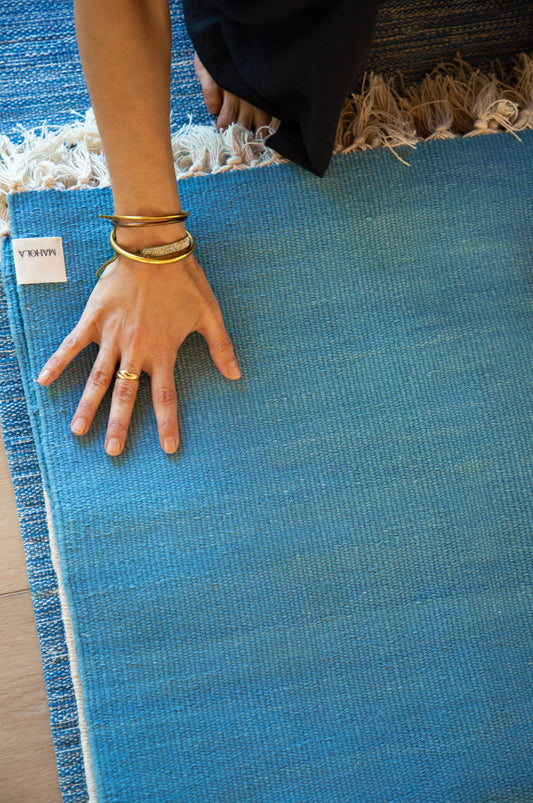
- Natural materials. Our mats are woven from GOTS-certified organic cotton, dyed with plants and fixed using the traditional Indian process. No PVC, no synthetic foam, no plastic coating. On the back, a thin layer of natural latex — less than 1% of the mass — stops the mat from slipping; it wears down and can be topped up.
- Artisanal manufacture. Every mat is made by hand in India by artisans trained in traditional weaving techniques, in decent working conditions and with fair pay.
- Packaging. Plastic-free, down to the adhesive tape where possible.
- Reforestation. Part of our revenue goes to projects that restore natural habitats and protect biodiversity.
We do not claim to have no impact. We grow cotton, we dye, we ship from India, we pack. The point is not to claim neutrality, but to reduce what can be reduced and to say what cannot.
A more responsible yoga
Nobody is perfect, and we all live with our contradictions. But every choice counts. By opting for equipment designed sustainably, you encourage a whole industry to change.
If you want the detail — the exact composition of the materials on the market, the applicable European regulations, and what really becomes of a mat at the end of its life — we have published a full, sourced investigation: What your mat doesn't tell you.