Releasing Emotions with Yoga: The Soothing Routine to Try

What if you could calm your inner storms simply by reconnecting with your breath, your body, and the present moment? Yoga, far more than a physical discipline, is a genuine practice of inner transformation. Rooted in an ancient tradition, this holistic approach seeks harmony between body, mind, and soul — a precious balance, especially when our emotions become too heavy to carry.
Yoga, an ally for releasing emotions
Repressed emotions or old wounds can imprint themselves on our bodies, sometimes without our knowledge. This is where yoga comes in: it helps us open inner spaces, bring what has been buried to the surface, and release the emotional tension we often carry unknowingly.
One of yoga's great strengths lies in its ability to cultivate mindfulness. By paying attention to our sensations, our movements, and our breath, we learn to reconnect deeply with ourselves. This self-presence is an essential first step toward emotional healing. To guide you on this path, here is a soothing routine to try, designed to gently release emotions and restore a state of inner calm.
1. Malasana (garland pose)

Technique: breathe deeply, start standing, feet spread hip-width apart. Turn your feet slightly outward. Bend your knees and lower your hips toward the floor. Keep your back straight and hips open, then place your hands on your knees or the floor to support your body. Keep your knees spread apart to allow your hips to open. Breathe deeply and steadily throughout the pose. Hold the pose for a few breaths.
Benefits:
- Releases emotional tension accumulated in the pelvis
- Stimulates energy circulation in the pelvic area
- Helps release body memories linked to stress or old wounds
- Promotes deep grounding and a feeling of inner stability
2. Virabhadrasana 2 (warrior 2 pose)

Virabhadrasana II combines the Sanskrit words Virabhadra, a powerful warrior from Hindu legend, and asana, meaning pose. Commonly known as Warrior 2 pose, it is a powerful posture that can help you build strength, balance, and self-confidence.
Technique: Start standing, feet spread about one leg's length apart. Turn your back foot slightly inward and your front foot 90°, pointing forward. Bend your front knee so it aligns above your ankle. Extend your arms out to either side, parallel to the floor, palms facing down. Look out over your front hand, keeping your core engaged and your chest upright.
Benefits:
- Strengthens emotional stability
- Cultivates confidence, focus, and determination
- Helps transform anger or blocked emotions into powerful action
- Awakens inner energy and stimulates the opening of the heart
3. Utkata Konasana (goddess pose)

This powerful pose helps reconnect with inner femininity while releasing emotional tension held in the pelvis.
Technique: Spread your legs wide, feet turned slightly outward. Bend your knees to align them with your ankles. Lower your hips toward the floor while keeping your back straight. Your arms can lift to shoulder height or come into a mudra at the heart.
Benefits:
- Releases emotional blockages linked to the pelvis and intimate area
- Strengthens the energy center (sacral chakra) linked to emotions
- Brings a feeling of gentle power, stability, and security
Caution: Avoid if you have knee or hip pain; adjust the width of your stance.
4. Marjariasana (cat pose)

Technique: On all fours, inhale while gently arching your back and lifting your head (cow pose). Exhale while rounding your spine and drawing your chin toward your chest. Alternate these movements in sync with your breath.
Benefits:
- Releases tension in the spine and shoulders
- Helps release emotions lodged in the upper back
- Soothes the nervous system and promotes a return to calm
5. Utthan Pristhasana (lizard pose)

In Sanskrit, Utthan means "forward stretch" and Pristha means "lizard." This deep, powerful pose mimics the low, attentive gait of the lizard — a symbol of adaptability and presence. It allows for an intense opening of the hips, often a storage site for unexpressed emotions.
Technique: From a low lunge, bring both hands inside your front foot. The knee can open out to the side. Rest your forearm on the floor if possible. Breathe deeply.
Benefits:
- Promotes the release of emotions repressed in the hips
- Stimulates the flow of vital energy
- Brings a feeling of letting go, sometimes intense but deeply liberating
Caution: Don't force it; stay within the right sensation.
6. Baddha Konasana (butterfly pose)

A gentle, effective classic for safely opening the hips.
Technique: Sitting, bring the soles of your feet together, knees relaxed out to the sides. Gently flap your legs like butterfly wings, then hold your feet and lean gently forward. Stay here for 5 to 10 deep breaths.
Benefits:
- Helps release emotional tension in the pelvis
- Brings a feeling of inner softness and comfort
- Stimulates mental relaxation and promotes introspection
7. Kapotasana (pigeon pose)

Technique: From downward-facing dog, bring your right knee between your hands, shin parallel to the mat. Extend your back leg and stretch your chest forward. Stay for several breaths before switching sides.
Benefits:
- Releases deeply buried emotional tension
- Relieves stress, sadness, or blocked anger
- Opens the heart and encourages forgiveness, toward oneself or others
Caution: Intense pose — use a cushion under the hip if needed.
8. Ananda Balasana (happy baby pose)

A playful, regressive pose that invites letting go and innocence.
Technique: Lying on your back, hold the insides of your feet with your hands, knees bent on either side of your torso. Gently rock from side to side.
Benefits:
- Releases tension in the lower back and pelvis
- Calms the mind and brings a feeling of inner security
- Encourages reconnection with the inner child
To finish
9. Anulom vilom

Anulom Vilom is a yogic Pranayama technique that involves alternating the breath between the two nostrils. This technique is also known as "alternate nostril breathing" or "Nadi Shodhana." "Anulom" means in the direction of the natural flow and "Vilom" against the natural flow.
Technique: Close one nostril: close one nostril with your thumb or index finger. Breathe through the other nostril: breathe through the other nostril. Switch nostrils: switch nostrils and breathe through the other one.
Benefits:
- Balances the body's solar and lunar energies.
- Balances the nervous system and emotions
- Purifies the energy channels (nadis)
- Reduces anxiety, mental rumination, and mood swings
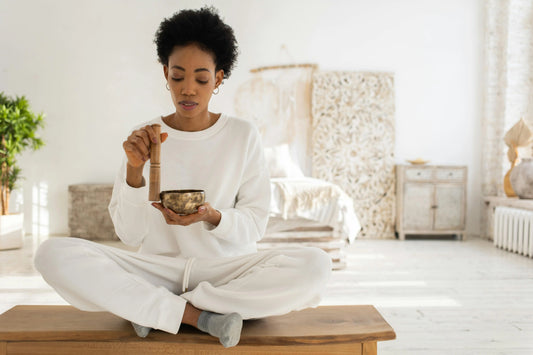
10. Meditation
To gently close this session, this short meditation will help you become aware of what you're feeling... then let go of what no longer belongs to you.
Technique: Settle into a seated or lying position. Close your eyes and bring your attention to your breath.
With each inhale, mentally say: "I welcome what I feel."
With each exhale: "I release what I no longer need."
Repeat gently, like a mantra, for 5 to 10 minutes. Let emotions come without judgment, and picture them drifting away like clouds in the sky.