Yoga on Holiday: A Way to Recharge

Vacation is much more than just a break from daily life: it offers a real opportunity to recharge and reconnect with yourself. Yet between travel, activities, and unexpected events, it isn't always easy to make the most of this precious time. Adding yoga to your vacation routine can help reduce stress, improve flexibility, promote restorative sleep, and bring you home feeling refreshed.
To get the most out of your vacation, you can practice yoga wherever you are: in a studio near where you're staying, in your room with an app, or out in nature to enjoy the scenery around you. A few simple gestures are enough to keep your energy up, recenter yourself, and savor each moment.
By finding a balance between discovery, relaxation, and well-being, you can adapt your routine and come home from vacation feeling regenerated and ready to face everyday life. A few ideas: practice yoga or meditation, do breathing exercises, take breaks to rest, eat a balanced diet, and connect with nature.
In this article, we offer you a routine for bringing yoga into your vacation, developed by an Indian yoga teacher, so that your free time is relaxing, restorative, and inspiring all at once.
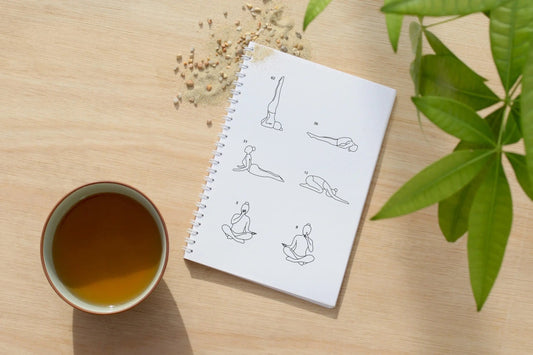
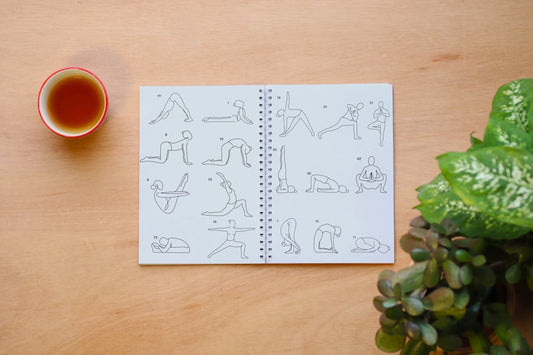
1. Bhujangasana (Cobra Pose)

To strengthen without straining: a gentle extension that activates the back muscles.
Technique: lying on your stomach, chin on the floor, hands under your shoulders, inhale and gently lift the upper body using the strength of your back. The arms support but don't push, just like the cobra, which has no arms or hands.
2. Balasana (Child's Pose)

Balasana, or child's pose, is a posture of comfort, relaxation, and grounding found in every yoga practice. Depending on its variations, it can also help stimulate digestion.
Technique: Kneel down, sitting your hips on your heels with your knees spread to hip width. Take a deep breath in and slide your hands forward. Gently let your back lengthen as you sit back on your heels, with your belly resting against your thighs. Your torso should touch the floor. To deepen the pose, stretch your arms far out in front, fingers on the floor in an inverted cup shape with your elbows lifted.
3 and 4. Bitilasana & Marjaryasana (Cow Pose & Cat Pose)


A fluid movement, extended, connected, and balanced.
Technique: Get down on all fours: knees under your hips, hands under your shoulders, fingers spread, index fingers pointing forward. The back is straight to start, arms extended. As you inhale, open the chest and gently arch the lower back (cow pose). The shoulders open, the shoulder blades draw together. Hold this position for a few seconds while retaining your breath. Then, as you exhale, round the back: tuck the pelvis, close the chest, bring the chin toward the chest, and look at your navel (cat pose). The head extends downward. Alternate slowly.
5. Ardha Matsyendrasana (Half Spinal Twist Pose)

Also known as "Lord of the Fishes pose," this position is excellent for spinal health. It also promotes better digestion, supports detoxification processes, and strengthens the whole body.
Technique: seated, right leg bent toward the perineum, left leg crossed over it. The right knee stays in contact with the floor. Gently turn your torso to the left, right hand on the left knee, the other hand behind you. Try to reach the knee or toes of the left foot with the right hand.
Benefits:
- Loosens the vertebrae, corrects misalignments
- Helps relieve arthritis
- Relieves back tension
- Aids digestion by massaging the abdominal organs (liver, gallbladder, spleen, pancreas
- Also stimulates the central nervous system and many ganglia located along the spine.
- Helps prevent lower back pain, herniated discs, and various forms of rheumatism.
Caution: avoid if you have acute intestinal sensitivity (diarrhea, abdominal pain). Do not force the twist.
6. Suptkapotasana (Reclining Pigeon Pose)

Suptkapotasana is a gentle pose done lying on your back that offers a deep stretch for the lower body. Derived from Sanskrit, supta means "lying on the back," kapota means "pigeon," and asana means "pose." It helps open the hips, stretch the glutes, and relieve tension in the lower back.
Technique: Lie on your back, knees bent and feet on the floor. Bring your right ankle onto your left thigh, near the knee. Slide your right hand between your legs to grasp your left hand, which wraps around the outside of the leg. Both hands interlock to hold the left leg behind the thigh or on the shin. To deepen the hip opening, you can use your right elbow to gently press the right thigh outward. Breathe deeply and hold the pose for a few breaths, then switch sides.
And to finish, a breathing exercise
7. Anulom Vilom (Alternate Nostril Breathing)

Anulom Vilom is a yogic Pranayama technique that involves alternating the breath between the two nostrils. This technique is also known as "alternate nostril breathing" or "Nadi Shodhana." "Anulom" means in the direction of the natural flow and "Vilom" against the natural flow. Practiced regularly, it helps release accumulated tension, slow racing thoughts, and promote a state of deep relaxation, ideal for drifting naturally into sleep.
Technique:
- Position: seated, on the floor or in a chair, back straight.
- Right hand: thumb on the right nostril, index and middle fingers folded in, and ring finger on the left nostril
Close the right nostril, inhale through the left. Close the left, exhale through the right. Inhale through the right. Close the right, exhale through the left. Repeat several cycles calmly.
How to choose your yoga mat for vacation
To make the most of your practice while on vacation, it's essential to choose a yoga mat suited to travel. Lightweight, foldable, and easy to carry, our SURYA and VIRAT models are designed to go with you anywhere, whether outdoors, at the beach, in the mountains, or even in your hotel room.
The SURYA 3mm is made from recycled cotton, embodying a spirit of resource preservation and reuse true to ancient traditions. Its non-slip finish provides optimal grip and exceptional durability, so you can focus fully on your postures. As for the VIRAT, its lightweight, flexible 3 mm format makes it easy to fold and carry, while offering comfort and stability for all your practices.
By choosing a suitable travel mat, you can keep practicing yoga wherever you are, preserving your energy, well-being, and serenity throughout your vacation.