Yoga routine for insomnia: getting back to sleep naturally

Insomnia is a sleep disorder that can deeply affect our physical and mental well-being. Difficulty falling asleep, waking up during the night, waking up tired… these symptoms affect many people, often linked to stress, anxiety, or an overly agitated mind.
Fortunately, yoga offers a natural, gentle, and accessible solution to promote better sleep. By adding a few targeted postures and breathing exercises to your evening routine, you can transform your nights.
The benefits of yoga against insomnia
- Reduces stress and anxiety: by calming the mind, yoga helps switch off the flow of thoughts that keep us awake.
- Improves relaxation: restorative postures and breathing induce deep physical relaxation.
- Regulates sleep cycles: regular practice can stabilize circadian rhythms and make it easier to fall asleep.
- Improves overall sleep quality: in particular by reducing nighttime awakenings and lengthening restorative sleep phases.
Possible causes of your sleep problems
In many cases, insomnia also results from an unbalanced lifestyle. Excessive consumption of coffee, tea, alcohol, or stimulants, irregular meal times, a disrupted rhythm, a lack of physical activity, or prolonged screen exposure can all disturb the nervous system. Even seemingly harmless things like overly intense music or an agitated movie can condition the body to stay on alert.
Yoga acts primarily on these deep causes: it reduces tension, soothes anxiety, and reconnects us to the present moment. It helps establish a state of inner security that is conducive to sleep.
Breathing, the key to a calm mind
The term Prana refers to the vital energy that flows within us, while Ayam refers to regulation or control. In yoga, breathing and mental state are closely connected. Pranayama exercises (controlled breathing) fully oxygenate the body, slow the heart rate, and calm the nervous system. By stimulating the parasympathetic system, they induce a state of calm conducive to sleep.
Here are two particularly effective pranayama techniques for breathing better and falling asleep more easily.
1. Anulom Vilom (alternate nostril breathing)

Anulom Vilom is a yogic pranayama technique that involves alternating breath between the two nostrils. This technique is also known as "alternate nostril breathing" or "Nadi Shodhana." "Anulom" means with the natural flow and "Vilom" against the natural flow. Practiced regularly, it releases accumulated tension, slows racing thoughts, and promotes a state of deep relaxation, ideal for drifting naturally into sleep.
Technique:
- Position: seated, on the floor or on a chair, back straight.
- Right hand: thumb on the right nostril, index and middle fingers folded, and ring finger on the left nostril.
Close the right nostril and inhale through the left. Close the left nostril and exhale through the right. Inhale through the right. Close the right nostril and exhale through the left. Repeat several cycles calmly.
2. Brahmari (the bee's breath)

Brahmari comes from the Sanskrit word "bhramar," which means black bee. This pranayama owes its name to the soft, continuous humming produced during exhalation, which resembles the sound of a bee. This vibrating sound has a profound effect on the nervous system: it soothes the mind, releases mental tension, and promotes a return to inner calm. It is a valuable tool for those who suffer from insomnia, mental restlessness, or anxiety. Brahmari breathing is particularly effective in the evening, before going to bed, to disconnect the mind and prepare the body for sleep.
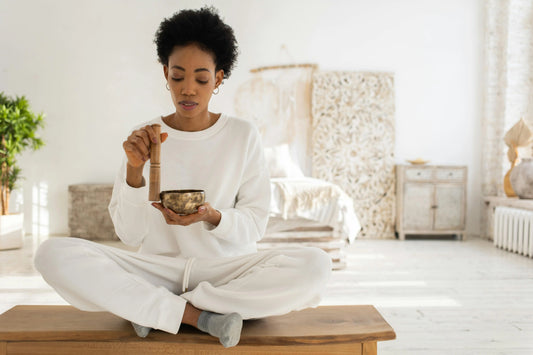
Technique: Sit comfortably, back straight, shoulders open. Close your eyes and inhale deeply through the nose, smoothly and silently. When exhaling, keep your mouth closed and produce a humming sound from your throat, like the buzz of a bee. Make sure the exhalation is long, steady, and soothing.
To enhance the relaxing effects, you can practice Yoni Mudra:
Place your index fingers on your closed eyelids, your middle fingers on your nostrils without blocking them, your ring fingers at the corners of your lips, and your thumbs on the ear cartilage to gently close your ears. This posture cuts off external stimuli and intensifies the sense of interiority. Repeat the exercise 5 to 10 times, taking time between each cycle to feel the effects.
Sequence of gentle postures to soothe the body
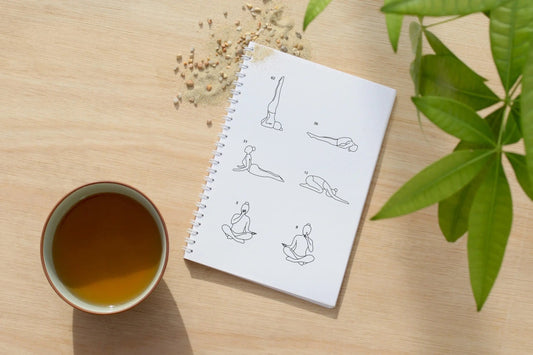
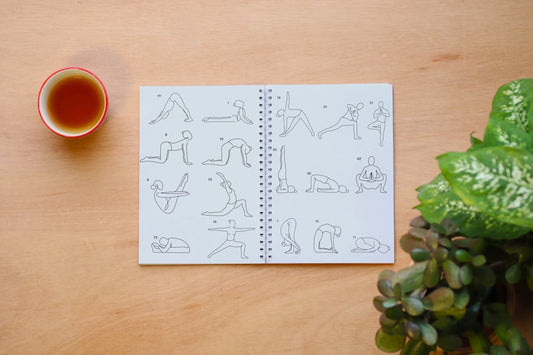
Once the mind is calm, it's essential to release accumulated bodily tension. Here is a series of postures to perform slowly, in a calm atmosphere conducive to sleep:
3. Vajrasana (the diamond pose)

Vajrasana, literally "the diamond pose," is a stable, meditative seated position often used for breathing exercises or after meals, as it aids digestion. At the end of the day, it naturally slows the breath, grounds the body, and brings attention back inward.
Technique: Kneel down, buttocks resting on your heels, back straight, hands resting on your thighs. Keep your knee joints together or very slightly apart depending on your comfort. Close your eyes, relax your shoulders, and breathe slowly through your nose. If this posture creates discomfort in the ankles or knees, place a cushion between your thighs and calves to support the pelvis.
4. Balasana (child's pose)

Balasana, or child's pose, is a posture of comfort, relaxation, and grounding found in all yoga practices. Depending on its variations, it can also stimulate the digestive process.
Technique: Kneel down, buttocks touching your heels and knees spread hip-width apart. Take a deep breath in and slide your hands forward. Gently let your back lengthen as you sit back on your heels, with your belly settling onto your thighs. Your front should touch the floor. To deepen the posture, stretch your arms far forward, fingers on the floor in an inverted cup shape, with elbows lifted.
5 and 6. Bitilasana & Marjaryasana (cat & cow pose)


A fluid movement that stretches, connects, and balances.
Technique: Get on all fours: knees under hips, hands under shoulders, fingers spread, index fingers pointing forward. The back is straight to start, arms extended. As you inhale, open your chest and gently arch your lower back (cow pose). The shoulders open, the shoulder blades draw closer together. Hold this position for a few seconds while holding your breath. Then, as you exhale, round your back: tuck your pelvis, close your chest, bring your chin toward your chest, and look at your navel (cat pose). The head hangs loosely. Alternate slowly.
7. Jathara Parivartanasana (belly twist)

The name Jathara Parivartanasana comes from Sanskrit: "jathar" meaning "abdomen," "parivarta" meaning "to turn," and "asana" meaning "pose."
Technique: Lie on your back, knees folded onto your chest. Inhale and exhale to stretch your lower back. Extend your arms out to shoulder height, palms facing up. On an exhale, let your knees drop to the right, guiding them toward your right elbow. Actively extend your left arm in opposition. Imagine the arm is weighed down by sandbags, while keeping your left shoulder blade on the floor. With each exhale, twist your abdomen to the left, moving your knees further away. Tuck your lower spine to stabilize and deepen the twist. Hold the position for 30 seconds, then bring your knees back to center and repeat on the left.
8. Ananda Balasana (happy baby pose)

A playful, regressive posture that invites letting go and innocence.
Technique: Lying on your back, grab the inside of your feet with your hands, knees bent on either side of your torso. Gently rock from side to side.
9. Savasana (corpse pose)

Savasana, or "corpse pose," is a posture of total relaxation, often practiced at the end of a session. It is a moment of integration, of complete letting go, where you allow body and mind to regenerate. It is ideal before bed to induce a state of deep calm.
Technique: Lie on your back, legs slightly apart, arms alongside your body with palms facing up toward the sky. Adjust your position until you feel perfectly comfortable: relax your feet, your face, your jaw. Close your eyes, breathe naturally, and let each exhale relax you a little more. Stay in the pose for at least five minutes, simply observing the inner calm settling in.
Create your evening ritual
More than just a physical routine, these practices can become a true evening ritual. Dim the lights, turn off your screens, play soft music. You can also light natural incense, such as sandalwood or lavender, for their soothing properties. The scent marks the moment of relaxation and creates a sensory anchor that promotes a return to calm every evening.
Start with a few minutes of breathing, then move through the postures at your own pace, in silence or with an audio guide. The goal is not performance, but reconnecting with yourself.
Conclusion
Insomnia is not inevitable. Yoga acts as a balm, for both body and mind. By cultivating this presence with yourself, by breathing fully and releasing tension, you create fertile ground for restorative sleep. This small, gentle, and accessible ritual can become a precious anchor in your daily life.